
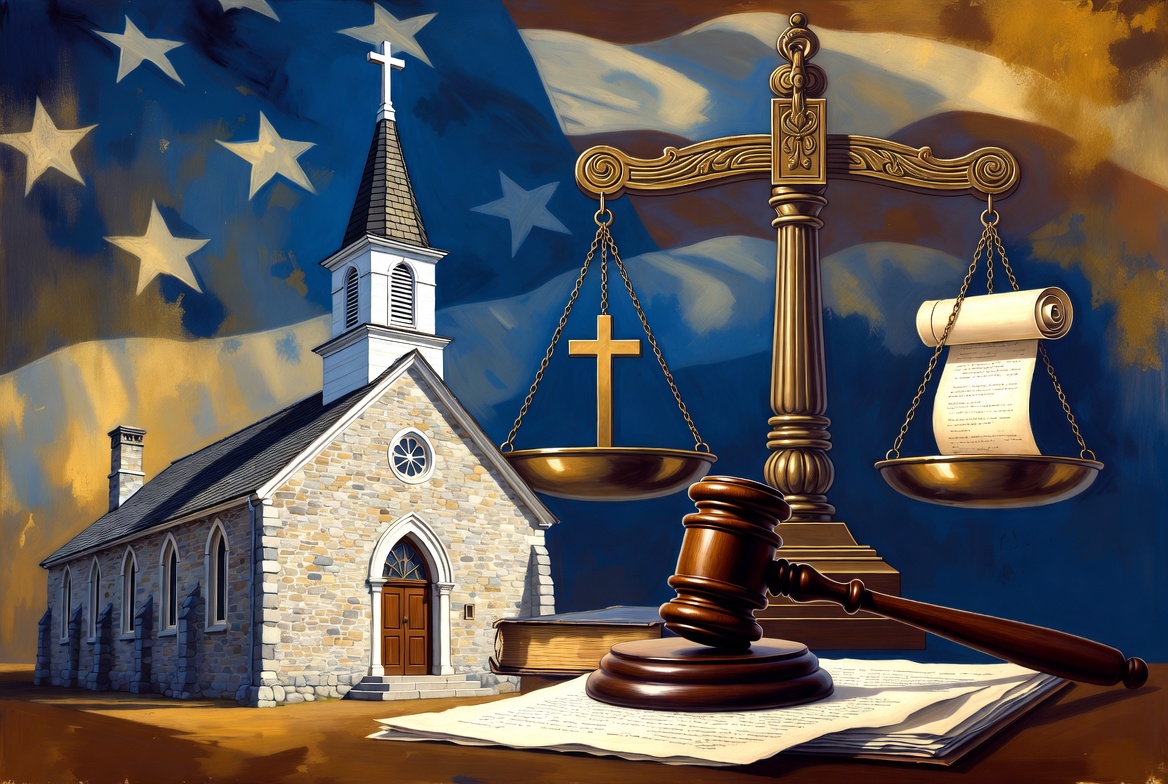
In a pivotal ruling, a Virigina court draws a “subtle but meaningful” line: faith communities enjoy protections, not exemption from the rule of law.
Everyone is under the law. That’s the conclusion of the Virginia Court of Appeals in its decision keeping a lawsuit against McLean Bible Church alive. McLean Bible Church, where the embattled David Platt pastors, argued the actions of its elders could not be reviewed by a court—in fact even discovery would be an intrusion into religious liberty. The court disagreed, offering this important warning:
“We embrace the perhaps subtle—but meaningful— distinction between a religious institution being ‘above the law’ and being subject to the law while still wielding significant privileges and protections.”
In other words, the court rejected the idea that church leaders can invoke religious liberty to avoid scrutiny. When a congregation adopts a constitution, it cannot later claim that enforcing it is an intrusion on faith. It’s a reminder that religious liberty protects belief and worship—not the unchecked power of institutional actors. Courts may not referee doctrine, but they can (at least in theory) enforce the promises churches make to their own members.
The plaintiffs argued that courts were actually defending the religious liberty of the congregation by preventing abuses like took place at McLean Bible Church.
The ruling goes further than simply reviving the case. As attorney Rick Boyer, who represents the former members challenging the church’s actions, noted, the Court of Appeals adopted the plaintiffs’ arguments almost wholesale.
“Crucially, they ruled that in the case of a congregational church, courts do have jurisdiction to determine whether the church followed its own rules, so it can be determined the actual ‘majority ruled’ according to those rules. This is huge for the plaintiffs,” Boyer said.
Again, this is important because it protects members of the church from abuses by those who would subvert a congregational church’s constitution.
The judges held that determining whether members missed eight consecutive meetings is a neutral principle of law, not a theological question, writing that “courts in Virginia are surely able to count to eight without entering a ‘religious thicket.’” They warned that allowing churches to block even preliminary inquiry “could swallow the neutral‑principles doctrine and present a great potential for abuse.”
Boyer pointed out how the tone of the opinion also shifted sharply from earlier hearings before the court. Where earlier rulings hinted that the dissenters might simply be agitators, this panel quoted the complaint’s allegation that the Board “sought to steal the election,” signaling a new willingness to take the claims seriously.
The ruling also stands in sharp contrast to the Fifth Circuit’s approach in McRaney v. NAMB, where the court treated nearly any internal church dispute as categorically off‑limits to civil review. That decision effectively allowed religious organizations to invoke “ecclesiastical abstention” as a blanket shield, even when the dispute involved no doctrine at all.
The Virginia Court of Appeals rejected that approach. Instead of deferring reflexively, it insisted on a factual inquiry, a balancing test, and the application of neutral principles before any First Amendment bar can apply—something the plaintiffs requested. In doing so, the court avoided the Fifth Circuit’s mistake: collapsing church autonomy into church immunity.
That difference matters. The Fifth Circuit’s sweeping deference in McRaney insulated religious organizations from any accountability, even when the dispute involved no doctrine and no theological judgment.
In contradistinction, the Virginia Court of Appeals recognized that the First Amendment protects belief—not procedural manipulation, not election‑rigging, and not the blatant disenfranchisement of dissenting members. Its approach preserves genuine church autonomy while preventing it from mutating into unreviewable power.
“We are grateful to the Court of Appeals for a ruling we believe was legally correct, and praise God for this outcome,” Boyer told the Capstone Report. “Back to Fairfax we go to debate the associational privilege issue.”
Bottom line: religious liberty belongs to the people, not the institution.